At a glance
For: Students, first-year students, prospective students, school pupils
Topics: Staggered start to studies, support during individual studies, academic support, skills analysis, heterogeneous entry qualifications
Joint project – Implementation : Getting Started , Time4ING , START SMART , Best study start for all, focus!ng
Location: Technische Hochschule Mittelhessen , RheinMain University of Applied Sciences, Fulda University of Applied Sciences, Darmstadt University of Applied Sciences, Frankfurt University of Applied Sciences
With more time and support, you can really get started
With an early assessment, targeted support, and time: The "Adapted Pace" (SaG) program allows for a more relaxed start to your studies, offering personalized guidance, additional courses on fundamentals and personal development, various practical projects, and networking opportunities. And because all of this is difficult to fit into a full curriculum, the start of your studies is extended by two semesters.
Studying at an adapted pace is interesting for anyone who feels they lack important foundational knowledge, for example, because their high school diploma was a few years ago, they are not entirely confident in their German language skills, or they are starting their studies with vocational qualifications. Studying at an adapted pace can be relevant for anyone who wants to take time for personal development, advancement, and in-depth learning.
The universities of Fulda (Start smart) and Darmstadt (The best start to studies for all), as well as the Technische Hochschule Mittelhessen (GettING started), have already developed various implementation concepts for a SaG (School Start to Studies) in a joint model project. During the QuiS funding period, these concepts will be sustainably established and rolled out. Building on the experiences and measures already implemented in the model project, RheinMain University of Applied Sciences (Time4ING) and Frankfurt University of Applied Sciences (focus!ing) are developing and testing corresponding pilot projects for selected departments.

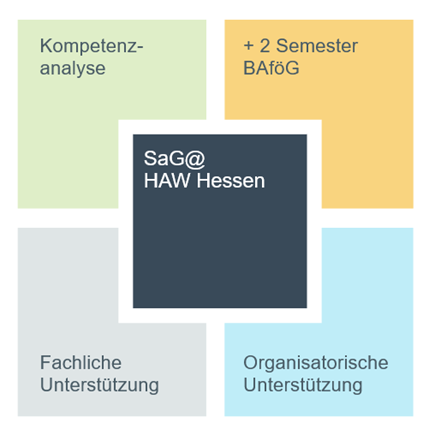
SaG, the Study of Adapted Speed – offers students professional support and guidance in their individual course of study when the standard period of study is extended by two semesters .
Elements of the study of adapted speed
Competence analysis
Right at the start of their studies, all first-year students in each degree program are asked to participate in a subject-specific skills assessment. This assessment is largely digital and tests both their skills in the foundational subjects of their respective degree programs and their self-assessment regarding their own motivation and self-efficacy. Based on the results, a possible change to the "degree program variant" is discussed with the participants in individual reflection and advising sessions.
Professional support
For participants in this study program variant, there are various supplementary offerings (mostly mandatory) within an intensively supervised learning group to align their knowledge and skill levels. These include, for example, support courses in the foundational subjects, supplementary internships and laboratory work, review sessions, exam preparation courses, open office hours and study periods, as well as project work to foster early identification with the field of study. In addition to the in-person sessions, there are e-learning resources and online courses for the foundational subjects.
+2 semesters BAföG
Participation in this study program variant extends the initial study phase by two semesters.
If eligibility for BAföG funding exists, it also applies to the additional two semesters.
Organizational support
In addition to academic support, SaG offers a wide range of organizational assistance. The project team provides intensive support to all participants during the initial phase and assists with individual study plan development. Personal mentors foster the participants' integration into university life. Furthermore, the "group mentoring" setting focuses on the diversity among participants and the role of the individual within the diverse student body.
Further measures aim to strengthen skills that extend beyond subject-specific knowledge and to prepare participants for self-directed learning. Project management, learning methods, self-organization, time management, and teamwork are practiced in small groups. Additional courses and workshops focus on imparting transferable skills. Excursions and internships serve to explore the professional field. The learning and reflection process is also supported by scenarios of digitally enhanced teaching and learning.
Implementation at the partner universities
Study program variant “GettING Started” , Technische Hochschule Mittelhessen
Time4ING , RheinMain University of Applied Sciences
START SMART , Fulda University of Applied Sciences
The best start to your studies for everyone , Darmstadt University of Applied Sciences
Course variant “focus!ng” , Frankfurt University of Applied Sciences
Contact person in
Dr. Susanne Reisinger , overall coordination of the SaG collaborative project (THM),