
Summary
QuiS_Flex: Flexibilization of studies and teaching at Hessian universities
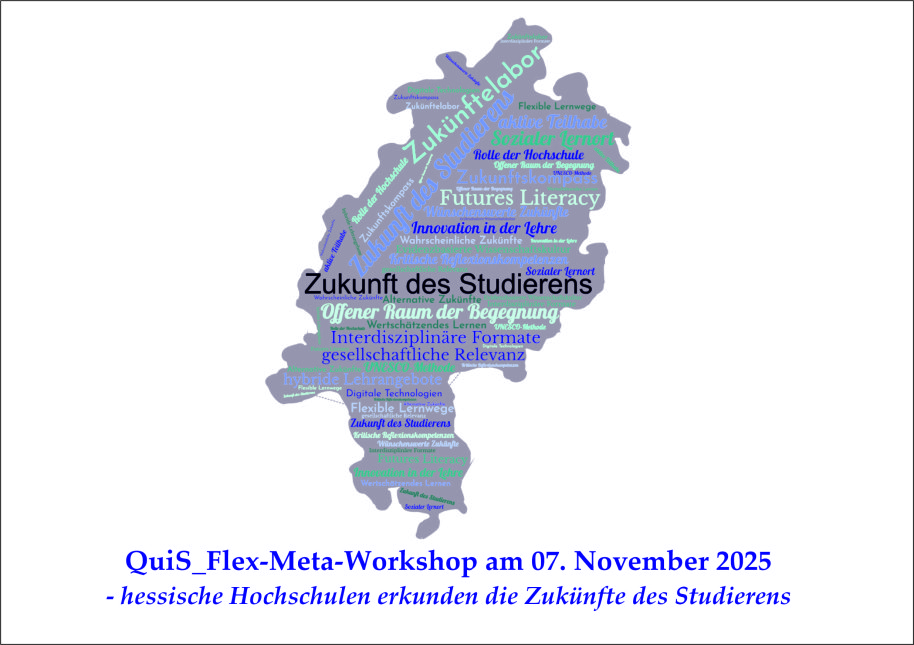
Representatives from Hessian universities and the Hessian Ministry of Higher Education, Research and the Arts (HMWK) met on November 7, 2025, in the auditorium of Justus Liebig University Giessen to develop new perspectives for higher education in 2035 at the QuiS_Flex meta-workshop "The Future of Studying." The day was based on the UNESCO Futures Literacy approach and offered space for creative thinking, exchange, and concrete ideas for action.
Diverse futures in view
At the beginning, Prof. Dr. Alexander Goesmann and Dr. Astrid-Solveig Loubal welcomed the guests and placed the event in the context of social and technological changes. The subsequent moderation was handled by economist and future literacy expert Dr. Stefan Bergheim and transformation consultant Valeria Berghoff-Flüel. The participants then began by working with different visions of the future in several steps:
The reflections on likely futures revealed a picture of a more digitized higher education landscape characterized by flexible learning pathways, interdisciplinary formats, and hybrid teaching offerings. The future student body will be more international and diverse, and will more frequently pursue part-time studies alongside employment. At the same time, the university will continue to be an important social space, facilitating exchange and interaction.
In exploring desirable futures, participants envisioned a modern yet human-centered university. They imagined a learning environment that enables individual pathways, strengthens self-efficacy, and fosters a respectful, dialogue-oriented learning culture. A central element of this vision was the idea of a university life that offers sufficient time and freedom for learning and personal development.
By deliberately changing underlying assumptions, alternative futures , consciously opening up unfamiliar and surprising scenarios. These helped participants to question familiar thought patterns and reveal new possibilities for action.
A shared compass for the future
In the next step, key desires were extracted from the diverse thoughts and ideas. These were condensed into a future compass that describes the university as an open space for encounters – a place where respectful learning, exchange, and experimentation are the norm. The compass emphasizes the importance of an evidence-based academic culture that makes societal relevance visible and empowers students to actively participate. It also highlighted the desire for individually tailored educational pathways that offer sufficient freedom while simultaneously promoting the responsible use of digital technologies, particularly AI.
Concrete action ideas
In conclusion, the participants developed initial recommendations for action. Topics ranged from the role of universities in societal change and how innovation can be sustainably integrated into teaching, to considerations regarding the future of subject structures and strengthening critical reflection skills in dealing with AI. These recommendations are to be taken up and further developed in subsequent inter-university exchanges.
The workshop clearly demonstrated the commitment and forward-thinking approach of Hessian universities in shaping the future of higher education. It provides an important starting point for further collaborations and the development of innovative ideas in university teaching.
Contact person
Dr. Astrid-Solveig Loubal , coordination quis_flex-meta