At a glance
For: Students, first-year students, prospective students, school pupils
Topics: Staggered start to studies, support during individual studies, academic support, skills analysis, heterogeneous entry qualifications
Joint Project – Study of Adapted Speed
Location: Frankfurt University of Applied Sciences
Course variant “focus!ng”
Two semesters at the beginning for a successful end – that sums up "focus!ng. My studies in focus!". This extended study option, offered in various engineering bachelor's degree programs, provides targeted support early on for first-year students who feel overwhelmed at the start of their studies.
In the focus!ng , the first two semesters of a degree program (introductory phase) are extended to four semesters, so that the standard period of study for a six-semester Bachelor's program is a total of eight semesters. During this extended introductory phase, fundamental knowledge is taught and practiced in small groups. Since mathematical skills, in particular, form an important and crucial foundation for engineering, a key focus is on closing any gaps in mathematical knowledge.
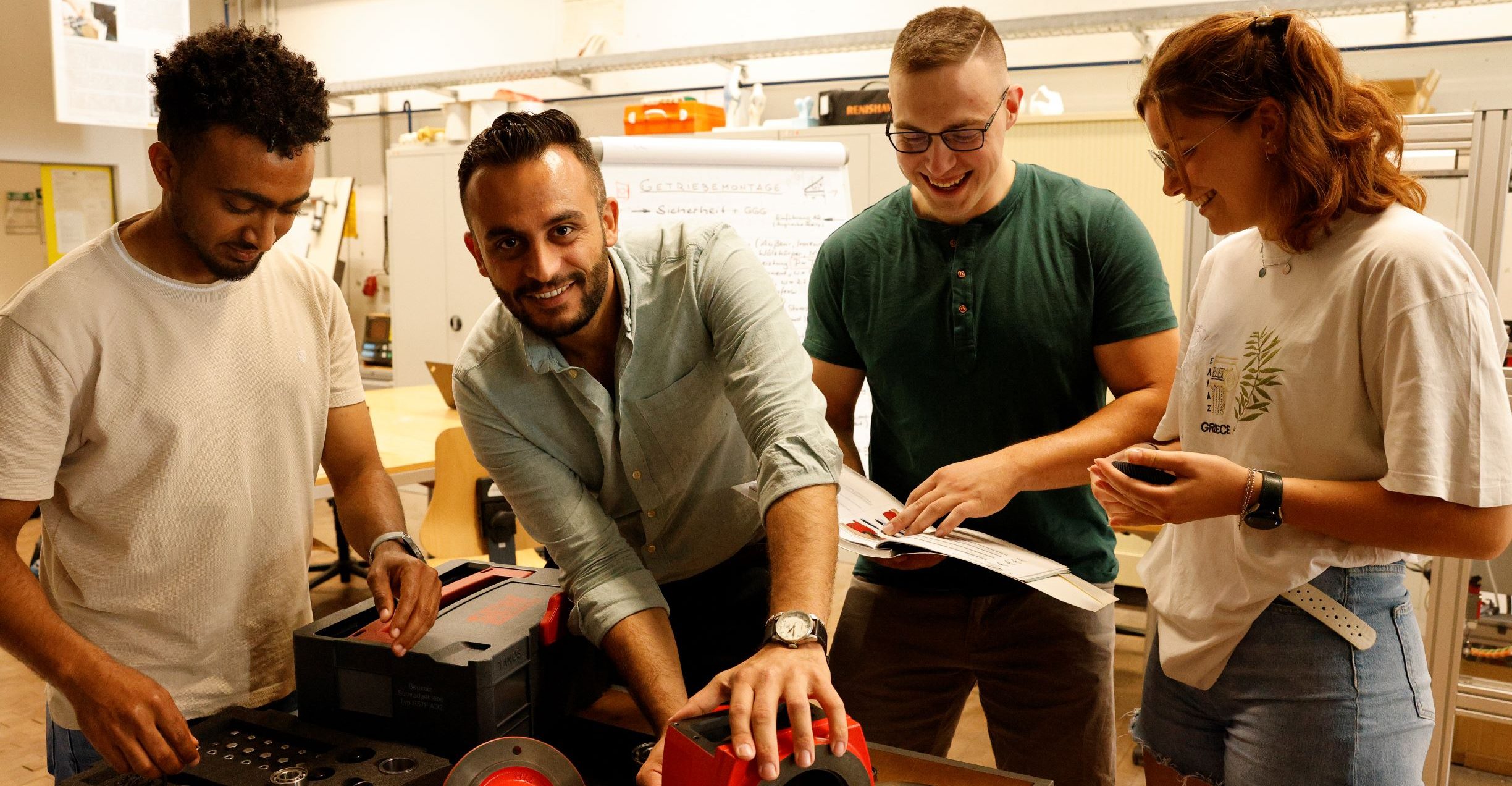
In addition to the core modules, focus!ng students take mandatory supplementary courses, for example, to orient themselves within the university system and in their future professional field (such as CAD or welding), participate in excursions to companies in the region, and attend lectures by company representatives. Furthermore, problem-based learning involves addressing practical questions in small, interdisciplinary projects.
The study program variant is eligible for BAföG funding and is characterized by intensive student support – the project coordinator accompanies the students throughout their entire studies.
The focus!ng variant is currently offered in the following degree programs:
- Mechanical engineering
- Product development and technical design
- Electrical and Information Engineering (starting in the winter semester of 2024/25)
Information on the joint project: SaG – Study of Adapted Speed
Contact person in
Katrin Hoedemacker-Etzin , Frankfurt University of Applied Sciences