Student Life Cycle: In-depth Phase
Target group: Students
University: Geisenheim University
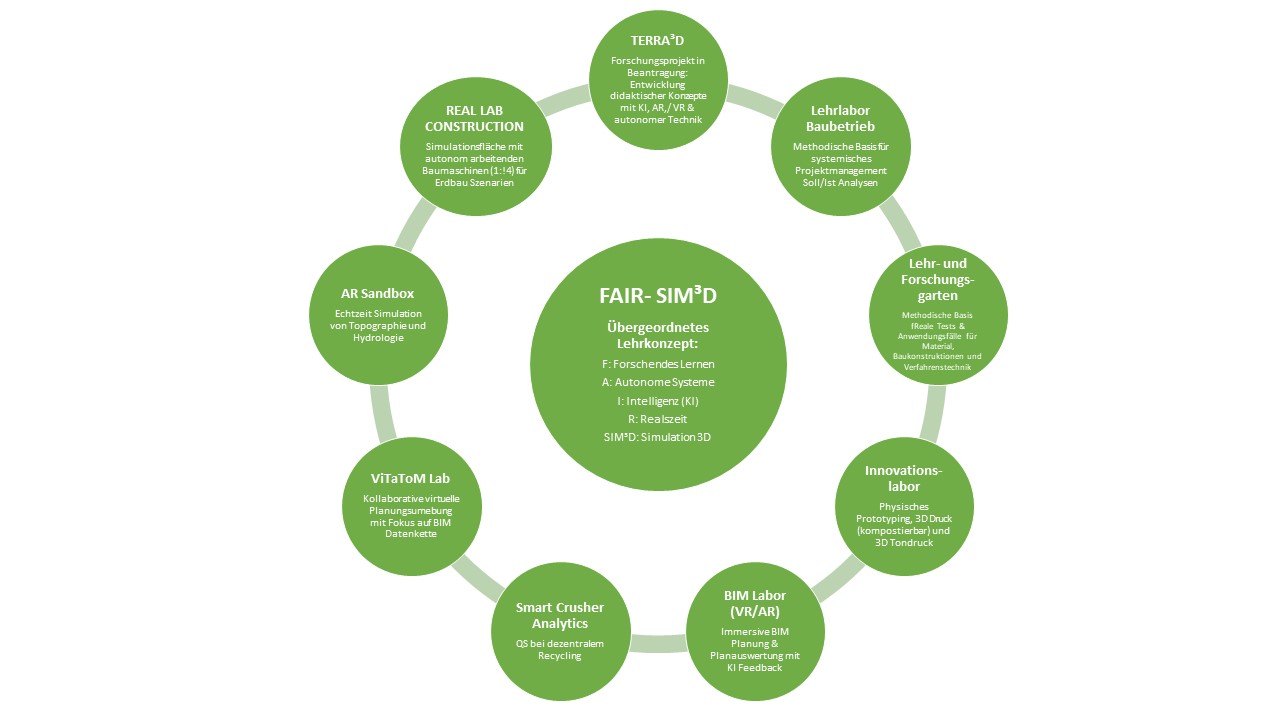
It links inquiry-based learning, big data, the use of AI in teaching, and BIM-supported communication. It enables students to practically explore real-world processes in earthworks, construction and vegetation technology, and digitalization through a scaled, interactive learning environment with AI applications. The goal is to develop a fully networked, AI-supported learning and research environment for simulating, analyzing, and evaluating real-world construction and vegetation processes
In a modular system consisting of six closely interlinked sub-projects, didactically sound, interactive spaces are created in which students can not only understand complex relationships between construction technology, vegetation technology, project management and digitalization through research-based learning, but also actively participate in shaping them.
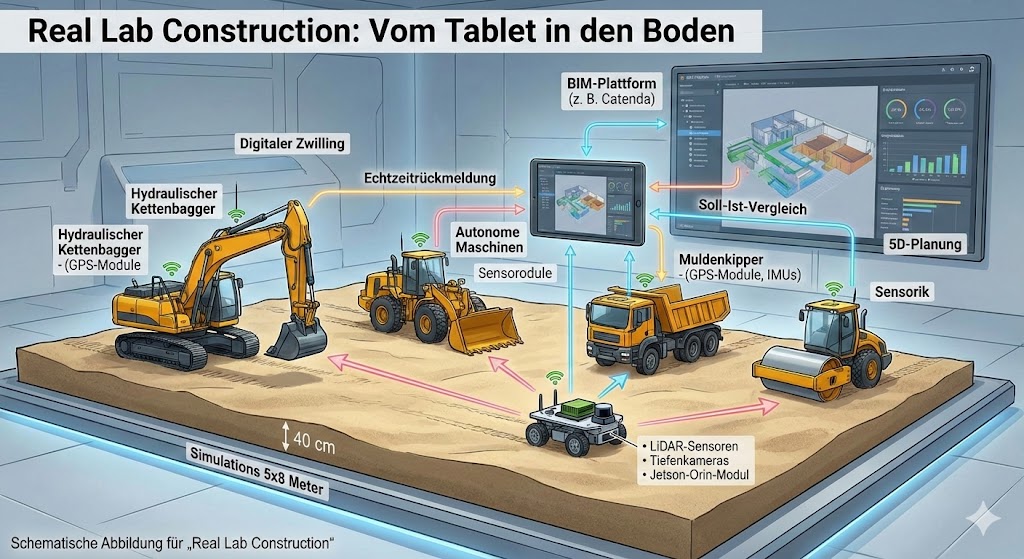
The centerpiece of the project is a simulation area measuring approximately 5x8 meters with a 40cm layer of sand, on which real-world earthwork situations are physically and digitally recreated at a scale of 1:14–1:16. Using AI-controlled construction equipment (tracked excavators, wheel loaders, dump trucks), an autonomous scout robot, and a planned laser projector, an interactive model construction site with real-time feedback is created. Sensors (LiDAR, IMU, depth cameras), Jetson-Orin processing units, and the Robot Operating System (ROS2) enable real-time processing, navigation, and response. Data integration is achieved via the Catenda BIM platform and is linked to as-is/to-be comparisons. This central system serves as the starting point and reference for all other sub-areas.
The core didactic aspect of the project lies in the practical integration of artificial intelligence (AI), big data, real-time simulation, BIM, VR/AR technologies, and immersive interaction surfaces into regular teaching. FAIR-SIM³D empowers learners to make informed decisions in the context of climate change-adapted planning and execution through their own data collection, AI-supported analysis, and feedback with digital models. This integration is directly incorporated into the teaching curriculum of the Institute for Landscape Construction and Vegetation Technology, particularly in the areas of civil engineering, vegetation technology, construction management, and project management.
Dr. Kai Oliver Thielking | kaioliver.thielking@hs-gm.de
Tel.: +49 6722 502-487
Geisenheim University / Andreas Thon / Thomas Muschkullus